Blog Contents

QuadRotors research by IIT-students (Robotekies)

Student Projects @ IIT-Delhi


IIT-Delhi-Open House


Open House is an annual event of IIT-Delhi, which held in IIT-Delhi on 24 April this year. IIT Delhi call upon various industries delegates and research scholar and also the students from all over Delhi visited IIT-d campus to have a look on various Innovative ideas which took a whole semester time to IIT-Delhi students  for molding ideas into reality. All the labs and machinery present at IIT were kept functional on this day.


Here, I have gathered some data of the products kept on display this time.  


Electronics

Transcend 8 GB Class 6 SDHC Flash Memory Card TS8GSDHC6E


Transcend 8 GB Class 6 SDHC Flash Memory Card TS8GSDHC6E


Transcend 8 GB Class 6 SDHC Flash Memory Card TS8GSDHC6


Transcend 8 GB Class 6 SDHC Flash Memory Card TS8GSDHC6


Belkin Neoprene Kindle Case (Fits 6" Display, Latest Generation Kindle) [Amazon Frustration-Free Packaging]


Belkin Neoprene Kindle Case (Fits 6" Display, Latest Generation Kindle) [Amazon Frustration-Free Packaging]


Flip UltraHD Camcorder, 120 Minutes (Black)


Flip UltraHD Camcorder, 120 Minutes (Black)


Brushless DC-Motors


Brushed vs. Brushless RC Motors


Standard "canned" Motor

A standard brushed motor is often referred as a canned motor. Every canned motor consists of the following parts:
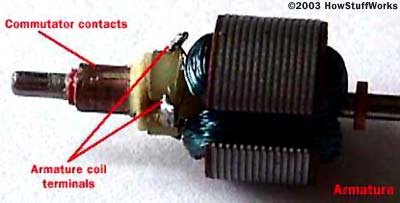
Armature- The rotating portion of the motor. It consists of the poles, terminals, and the commutator.


rc motor armature
Poles- Copper wires wound around a piece of metal forming an electromagnet. The poles are attached to the armature. Most motors have 3 or more poles
Terminal- Point at which the copper wire of a poll attaches.
Commutator- A switch on the armature that reverses the current to the poles every 1/2 rotation so that the magnetic fields of each will always maintain rotation.
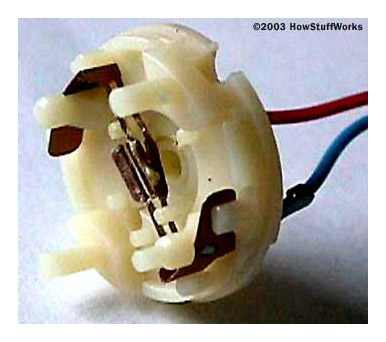
Brushes- Tabs in the motor cap that are wired to the battery and make contact with the plates on the commutator as the armature rotates.
RC motor brush RC electric motor
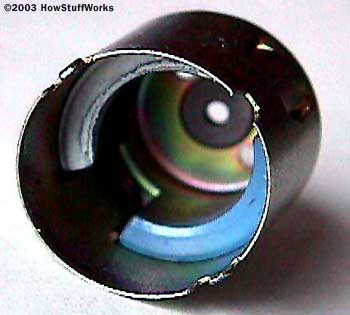
Magnets- The outer shell (or can) of the motor is lined with two permanent magnets, of opposite polarity. This non-rotating portion of the motor is also referred as the motor stator.
rc motor can


The battery is wired directly to the brushes. The brushes make contact with the plates of the commutator as the motor turns. There are the same number of plates on the commutator as there are poles on the armature.


When the brushes come in contact with the appropriate plates of the commutator, a particular pole (electromagnet) is charged. When a pole is charged, it is attracted to one of the magnets in the can and repelled by the other.


The commutator acts as a switch by switching the polarity of each pole every time the pole passes a magnet. When the polarity is switched, the pole is attracted to the next magnet in the can while being repelled by the one it just passed. This process repeats as long as power is supplied to the motor.

Instruction Set-8051


Alphabetical List of Instructions


Just click on the Instruction Set to study.
  • ACALL: Absolute Call
  • ADD, ADDC: Add Accumulator (With Carry)
  • AJMP: Absolute Jump
  • ANL: Bitwise AND
  • CJNE: Compare and Jump if Not Equal
  • CLR: Clear Register
  • CPL: Complement Register
  • DA: Decimal Adjust
  • DEC: Decrement Register
  • DIV: Divide Accumulator by B
  • DJNZ: Decrement Register and Jump if Not Zero
  • INC: Increment Register
  • JB: Jump if Bit Set
  • JBC: Jump if Bit Set and Clear Bit
  • JC: Jump if Carry Set
  • JMP: Jump to Address
  • JNB: Jump if Bit Not Set
  • JNC: Jump if Carry Not Set
  • JNZ: Jump if Accumulator Not Zero
  • JZ: Jump if Accumulator Zero
  • LCALL: Long Call
  • LJMP: Long Jump
  • MOV: Move Memory
  • MOVC: Move Code Memory
  • MOVX: Move Extended Memory
  • MUL: Multiply Accumulator by B
  • NOP: No Operation
  • ORL: Bitwise OR
  • POP: Pop Value From Stack
  • PUSH: Push Value Onto Stack
  • RET: Return From Subroutine
  • RETI: Return From Interrupt
  • RL: Rotate Accumulator Left
  • RLC: Rotate Accumulator Left Through Carry
  • RR: Rotate Accumulator Right
  • RRC: Rotate Accumulator Right Through Carry
  • SETB: Set Bit
  • SJMP: Short Jump
  • SUBB: Subtract From Accumulator With Borrow
  • SWAP: Swap Accumulator Nibbles
  • XCH: Exchange Bytes
  • XCHD: Exchange Digits
  • XRL: Bitwise Exclusive OR
  • Undefined: Undefined Instruction

Power Management in 8051

POWER MANAGEMENT IN 8051
·         YOU KNOW WHAT……microcontroller is inactive for the most part and just waits for some external signal TO ACT UPON ANYTHING.
·         So it is regarded as the wastage of energy if not controlled.
·         We can change its program in such a way which reduces its total consumption to approximately 40uA.
·         There are two power-saving modes of operation::
1.    Idle 
2.   Power Down.


PCON register 

The purpose of the Register PCON bits is:
·         SMOD Baud rate is twice as much higher by setting this bit.
·         GF1 General-purpose bit (available for use).
·         GF0 General-purpose bit (available for use).
·         PD By setting this bit the microcontroller enters the Power Down mode.
·         IDL By setting this bit the microcontroller enters the Idle mode.


Idle mode
·         If  the IDL bit of the PCON register is set, the microcontroller turns off the greatest power consumer- CPU unit while peripheral units such as serial port, timers and interrupt system continue operating normally consuming 6.5mA.
·         In Idle mode, the state of all registers and I/O ports remains unchanged.
·         In order to exit the Idle mode and make the microcontroller operate normally, it is necessary to enable and execute any interrupt or reset. It will cause the IDL bit to be automatically cleared and the program resumes operation from instruction having set the IDL bit.


Power Down mode
·         By setting the PD bit of the PCON register from within the program, the microcontroller is set to Power down mode, thus turning off its internal oscillator and reduces power consumption enormously.
·          The microcontroller can operate using only 2V power supply in power- down mode, while a total power consumption is less than 40uA.
·         The only way to get the microcontroller back to normal mode is by reset.
·         While the microcontroller is in Power Down mode, the state of all SFR registers and I/O ports remains unchanged.
·         By setting it back into the normal mode, the contents of the SFR register is lost, but the content of internal RAM is saved.
·         Reset signal must be long enough, approximately 10mS, to enable stable operation of the quartz oscillator.

verification

"This post confirms my


ownership of the site and that this site adheres to Google AdSense program

policies and Terms and Conditions."

Followers

Robotekies

Robotekies
Click To Visit Our Web Portal

QuadRotors

A quadrotor, also called a quadrotor helicopter, is an aircraft that is lifted and propelled by four rotors.

There exist two generations of quadrotor designs.

-first generation quadrotors were designed to carry one or more passengers.

-more recent generation of quadrotors are commonly designed to be unmanned aerial vehicles.

QuadRotor

QuadRotor
Our Research Area

Search This Blog