Brushed vs. Brushless RC Motors
Standard "canned" Motor
A standard brushed motor is often referred as a canned motor. Every canned motor consists of the following parts:
Armature- The rotating portion of the motor. It consists of the poles, terminals, and the commutator. | 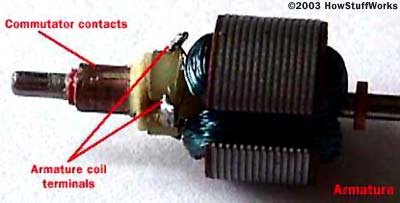 |
Poles- Copper wires wound around a piece of metal forming an electromagnet. The poles are attached to the armature. Most motors have 3 or more poles
Terminal- Point at which the copper wire of a poll attaches.
Commutator- A switch on the armature that reverses the current to the poles every 1/2 rotation so that the magnetic fields of each will always maintain rotation.
Brushes- Tabs in the motor cap that are wired to the battery and make contact with the plates on the commutator as the armature rotates. | 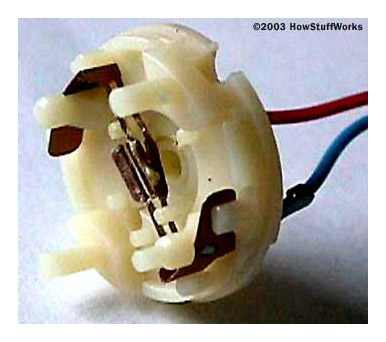  |
Magnets- The outer shell (or can) of the motor is lined with two permanent magnets, of opposite polarity. This non-rotating portion of the motor is also referred as the motor stator. | 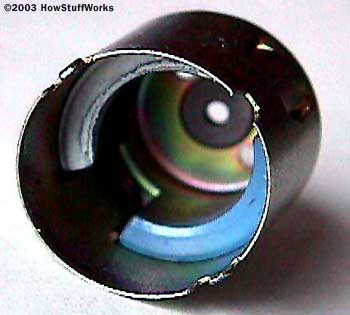 |
The battery is wired directly to the brushes. The brushes make contact with the plates of the commutator as the motor turns. There are the same number of plates on the commutator as there are poles on the armature.
When the brushes come in contact with the appropriate plates of the commutator, a particular pole (electromagnet) is charged. When a pole is charged, it is attracted to one of the magnets in the can and repelled by the other.
The commutator acts as a switch by switching the polarity of each pole every time the pole passes a magnet. When the polarity is switched, the pole is attracted to the next magnet in the can while being repelled by the one it just passed. This process repeats as long as power is supplied to the motor.


No comments:
Post a Comment